Prospective clients research legal problems at their most stressed. They search, they ask AI tools, they read reviews, and they call the firm that seems to understand their situation. We make sure that firm is yours.
SEO for law firms is the work of making your practice-area pages, local presence, lawyer profiles and reviews easy for Google and AI assistants to find and trust, so people with a legal problem shortlist your firm. It covers one strong page per practice area, Google Business Profile and local search, technical health, legal directories, compliant reviews and answer-first content, all written within the Australian Solicitors' Conduct Rules and state advertising restrictions.
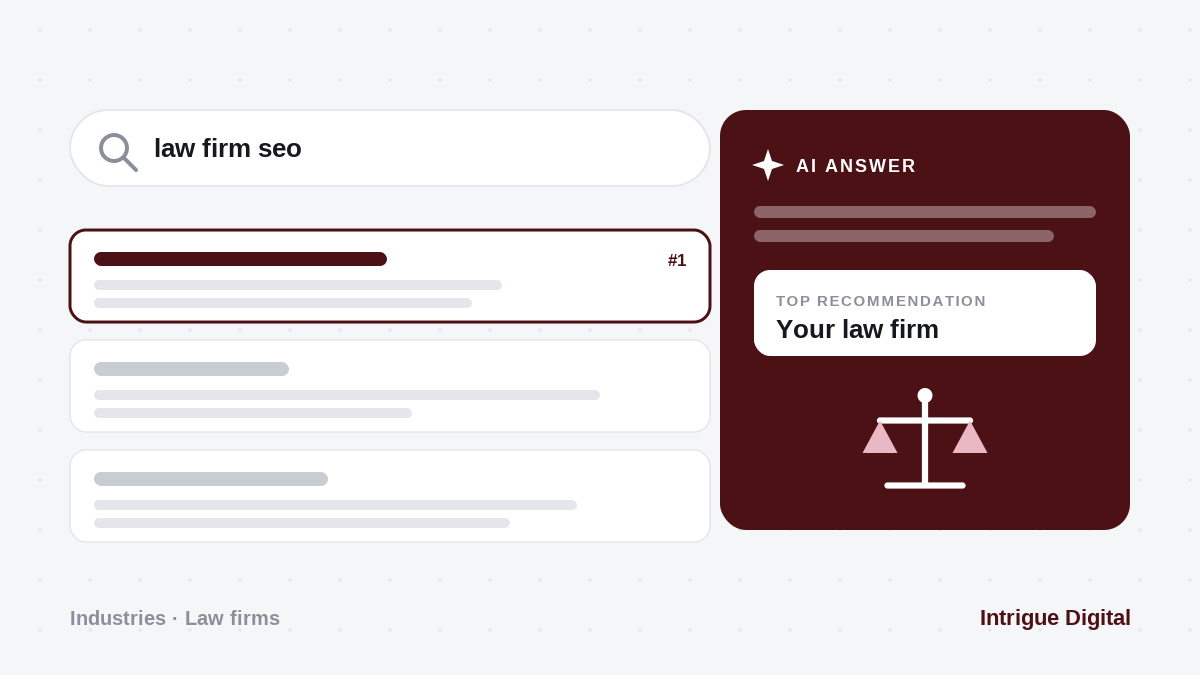
Someone facing a separation, a charge, a dispute or a property settlement rarely calls the first firm they see. They search for their specific problem, read two or three firms' pages, check reviews and increasingly ask an AI tool to explain their options or suggest firms. By the time they call, the shortlist is set.
That means the firms that win are the ones with clear, specific practice-area pages, consistent credentials across the web and enough reviews to look established. We have done this before: SLB Legal's tracked practice-area keywords hold first-page positions on Google.
One strong page per area, such as family, criminal defence, wills and estates, conveyancing, commercial or employment, each answering the questions clients actually ask.
Google Business Profile, map pack and suburb pages for the areas your clients live and work in.
Fast, clear pages for urgent searches such as bail, drink driving and court appearances, where the first credible firm usually gets the call.
A compliant review process plus accurate listings on legal directories and professional bodies.
Structured content and credentials so AI tools describe your firm and services accurately.
Clear next steps, fast contact options and tracking, so you know which matters came from search.
Legal services advertising is regulated under the Legal Profession Uniform Law and state-specific rules, and some states restrict how personal injury services can be advertised. We never promise outcomes, never use misleading comparisons and never publish testimonials in a way that breaches your obligations. Every page is approved by your firm before it goes live.
We also work to one firm per practice area, per postcode, so we will not build the same visibility for the firm across the road.
The most common reason a law firm doesn't rank is a single "Services" page trying to cover everything. Google and AI tools match a search to the page that answers it best, so a family law query needs a family law page, and ideally pages for the specific problems within it, such as property settlement or parenting arrangements.
Each practice-area page should open with a direct answer, name the state or territory (law differs across jurisdictions), explain the process and likely costs in plain English, introduce the lawyer who does the work, and make the next step obvious.
| Practice area | What clients search | What the page must answer |
|---|---|---|
| Family law | property settlement after separation, how custody works in [state] | Steps, timeframes, cost ranges, when to get advice early |
| Criminal defence | drink driving lawyer near me, bail application | What happens next, urgent contact, court locations you cover |
| Wills and estates | how to contest a will, probate in [state] | Eligibility, time limits, who pays, documents needed |
| Conveyancing | conveyancing fees [suburb], buying off the plan | Fixed-fee options, what is included, settlement timeline |
| Employment | unfair dismissal lawyer, 21-day time limit | Deadlines, Fair Work process, employer versus employee advice |
| Commercial | shareholder dispute lawyer, contract review cost | Typical matters, how fees work, who the right contact is |
Search phrases reflect the questions clients type and ask AI tools; volumes vary by city and state.
Most legal searches carry local intent, even when the person doesn't type a suburb. Google shows a map pack of three firms above the regular results, and those three get a large share of calls. Getting into it depends on proximity, relevance and prominence.
For relevance, choose the most specific Google Business Profile categories (for example "Family law attorney" rather than only "Lawyer"), list every practice area as a service and add your service areas. For prominence, build steady, genuine reviews and consistent listings on your state law society directory and legal directories. For multi-office firms, give each office its own profile and its own location page with real local detail, never a template with the suburb swapped.
Legal websites are often built once and left alone for years. These are the technical issues we fix most often, and why they matter for a firm specifically.
| Check | Why it matters for a law firm |
|---|---|
| Mobile speed under about 2.5 seconds | People search for urgent legal help on their phone; slow pages lose the call |
| One indexable page per practice area | Thin or duplicate pages split rankings and confuse AI tools |
| LegalService, Attorney and FAQ schema | Tells Google and AI exactly what you do, where, and who your lawyers are |
| Lawyer profile pages with admission details | Supports trust signals for a "your money or your life" topic |
| Click-to-call and short contact forms | Most enquiries happen on mobile, often after hours |
| AI crawlers allowed in robots.txt | Blocking OAI-SearchBot or Bingbot can keep you out of ChatGPT and Copilot answers |
| Search Console and Bing Webmaster Tools set up | You can't fix what you can't see; Bing also feeds Copilot |
People increasingly ask ChatGPT, Gemini or Google's AI Overview to explain a legal problem and suggest who to call. A 2026 study of 1,110 US consumers by legal marketing firm iLawyer Marketing found the share using ChatGPT to research lawyers rose from 28.1% to 41.9% in a year. AI tools recommend firms whose pages answer the question clearly for the right jurisdiction, and whose details are confirmed by outside sources such as directories, reviews and media comment.
We test the questions your clients ask across the major AI tools each month, record whether your firm is named, and fix the gaps. See AI SEO (AEO and GEO) for how this works.
Legal is one of the most competitive search categories, with some of the most expensive Google Ads clicks of any industry. Organic search is the long-term alternative to paying for every click. Intrigue plans start at A$1,500 a month (Starter) and A$3,500 a month (Growth), with a three-month minimum, and include SEO, AEO and GEO together. Multi-office firms are scoped individually. See pricing, or estimate what more enquiries are worth with the SEO ROI calculator.
Choosing an agency? Our guide on how to choose an SEO agency for a law firm covers the questions to ask and the red flags to avoid.
We would rather show you than tell you. Here is a client in their own words, alongside tracked results, including a law firm.
A client in their own words. Tap to play with sound.
Tracked practice-area keywords holding first-page positions on Google, the terms that bring in commercial legal clients. See the site →
Ranked second for "Melbourne fire doors", a high-trust compliance search where the first credible business gets the call. See the site →
First page of Google for "life coach Melbourne", one of the most competitive coaching searches in the country. See the site →
Independent research on search and AI behaviour, last reviewed October 2026. We re-check these figures at least every six months.
It depends on competition in your area, how many practice areas you cover and how many offices you have. Intrigue plans start at A$1,500 a month with a three-month minimum, and include SEO, AEO and GEO.
Local SEO helps your firm appear in Google's map pack and in local results when people search for a lawyer near them. It relies on a complete Google Business Profile with specific categories, consistent details across directories, genuine reviews and a location page for each office.
Fast mobile pages, one indexable page per practice area, LegalService and FAQ schema, lawyer profile pages, click-to-call, and AI crawlers allowed in robots.txt so tools like ChatGPT and Copilot can read your site.
Generally yes, as long as they are genuine, not misleading and don't breach confidentiality or state advertising rules. Never offer incentives for positive reviews, and when replying, thank the reviewer without confirming any details of their matter.
Yes. SEO is mostly about clear, accurate, helpful information, which fits well within legal advertising rules. We avoid outcome promises, misleading claims and restricted advertising categories, and your firm approves all content.
Areas where clients research before calling, such as family law, criminal defence, wills and estates, conveyancing, employment and commercial disputes. Urgent areas such as criminal defence also benefit from fast, local visibility.
Legal search is competitive, so expect steady progress over several months. Local visibility and AI-answer improvements can show earlier, which is why we start with Google Business Profile, practice-area pages and reviews.
Yes. Many of the strongest local results come from smaller firms that focus on a few practice areas and do them properly online.
Book a free 30-minute strategy call. One business per industry, per postcode, so your direct competitor can't buy the same spot.
 Intrigue Digital