 Intrigue Digital
ChatGPT named us for medical practices, but not for dentists. Here is what we changed.
True Tally Bookkeeping works with dental practices, allied health clinics and professional services firms across Australia. When they tracked how ChatGPT recommends bookkeepers, they were the first choice for one profession and invisible for another. Here is why, and what they changed.
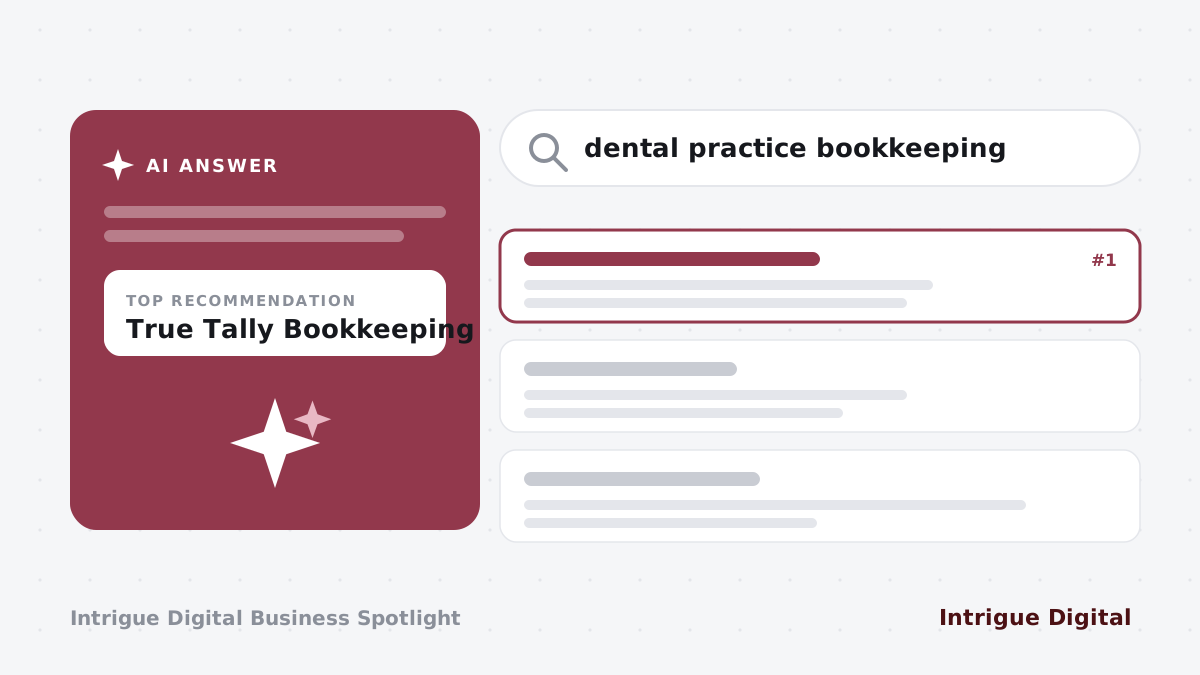
Has AI recommended you, or ignored you?
Both, depending on the question. We track 15 buyer-style questions in ChatGPT, the kind of thing a practice owner types when they are looking for a bookkeeper. Over the last month, True Tally Bookkeeping was named in about one answer in five.
Where we were named, it went well. For "best bookkeeper for a medical practice or GP clinic in Australia", one answer put us first and called us its first choice nationally, quoting our Medicare and bulk-billing reconciliation work. We also showed up for SCHADS Award payroll and for "best bookkeeper in Geelong".
Where we were not named was the surprise. We do a lot of dental practice bookkeeping, yet "best bookkeeper for a dental practice" did not mention us. Neither did the questions about psychology practices, NDIS claims, or cash flow bookkeeping for service businesses. Those are some of our core clients.
We were the first choice for medical practices and invisible for dentists. Same team, same skills, different pages.
What did the AI pick instead?
The firms that won those answers had one thing we did not: a dedicated page for that exact profession. A psychology practice question pulled up competitors with a page called "bookkeeping for psychologists". An NDIS claims question pulled up businesses whose whole page was about NDIS claims.
The other pattern was where the answers came from. Of all the sources ChatGPT cited across our tracked questions, roughly 94% were other websites, and only about 5% were our own pages. Industry directories, comparison articles, government sites and competitors' service pages did most of the talking. One of the most cited sources for "bookkeeper Geelong" was an accounting software partner directory where a competitor was listed and we were not.
What have you changed because of AI search?
- One page per profession, written for the buyer. We are building national service pages for each type of practice we work with. The first, psychology practice bookkeeping, covers Medicare Better Access reconciliation, GST on reports and supervision, and associate splits. It sits alongside our existing allied health bookkeeping and medical practice pages, with physiotherapy, occupational therapy and speech pathology next.
- Specific answers to specific questions. Dental owners ask about chair utilisation, lab fees, associate splits and service and facilities agreements, so that is what we write about. Professional services firms, such as law firms and other professional practices, ask about work in progress, billing cycles and cash flow between matters. Generic "we do bookkeeping" copy does not get cited.
- Publishing beyond our own website. We now write exclusive articles for Medium and LinkedIn on health and dental practice finances, each linking back to the relevant service page, and list them all on our press page. They give AI assistants more independent sources that describe what we do.
- Fixing how we are described. One answer described our registration with the wrong title. Our correct registration is Registered BAS Provider 26360186, and we are now making sure that exact wording appears everywhere: our site, LinkedIn, Medium and every directory. Some answers also treated "True Tally" and "True Tally Bookkeeping" as two different businesses, so we now use the full name consistently.
- Checking the directories AI reads. We are reviewing our listings on the software partner directories and review sites that showed up as cited sources.
- Measuring it every month. We re-check the same questions monthly and are adding new ones for dental, physiotherapy and occupational therapy, so we can see whether each change moves the answer.
What is your biggest worry?
Being described wrongly. In our industry, registrations are regulated by the Tax Practitioners Board, so a practice owner choosing a bookkeeper should be able to rely on what they read. When an AI assistant gets a credential slightly wrong, it is not just a branding problem. It is the kind of detail a careful dentist or practice manager checks, and it should be right.
The second worry is the size of the shortlist. If a practice owner asks for three bookkeepers and gets three names, there is no page two. Either we are one of the three or we are not in the conversation.
What do practices get from working with you?
Practice owners want three things from an outsourced bookkeeper: compliance they never have to think about, books that are up to date, and numbers that help them make decisions. A few of the results we point to:
- No late BAS. We have never lodged a late BAS for a client, which matters when GST-free health services and taxable work sit side by side in the same practice.
- Catch-up in weeks, not months. When a practice comes to us behind, we typically have the books caught up within four weeks, so the owner is working from current numbers again.
- Margin reviews that pay for themselves. The biggest value we add is often a margin review. For one client, it found $30,000 in savings. For dental and allied health practices, that usually means looking at associate splits, lab fees, consumables and practitioner utilisation.
- Payroll done properly. Award rates, super at 12% and Single Touch Payroll for health and care teams, including SCHADS Award payroll for NDIS and community providers.
Our take: why this is the case for AI search
AI answers reward specificity. True Tally does the same quality of work for a GP clinic and a dental practice, but only one of those had a page that answered the exact question. AI assistants match the question to the most specific credible source they can find. For specialist service firms, that means one clear page per profession, written around the questions those buyers ask.
Most of the evidence lives off your website. When around 94% of cited sources are third-party sites, your own pages are only part of the story. Directories, partner listings, articles on platforms like Medium and LinkedIn, and consistent descriptions everywhere decide whether an AI is confident enough to name you.
Accuracy is part of visibility. In regulated professions like bookkeeping, dental, allied health and law, getting the credentials and details exactly right everywhere is both a trust signal for AI and a compliance issue for you. We cover the publishing side in LinkedIn vs Medium vs your website.
Frequently asked questions
What does a bookkeeper for a dental practice do?
A dental practice bookkeeper reconciles HICAPS and payment terminal settlements back to your practice software, codes GST-free treatment separately from taxable cosmetic work, checks associate dentist payments against their agreements, runs payroll for the support team and prepares the BAS. Good ones also report the numbers that drive a practice, such as chair utilisation, collections and lab fees as a share of production.
What is allied health bookkeeping?
Allied health bookkeeping is bookkeeping set up for physiotherapy, psychology, occupational therapy, speech pathology and similar practices. It covers reconciling Medicare, health fund, NDIS and private payments against the practice software, correct GST coding for health services, practitioner splits and payroll, and reporting by practitioner so owners can see utilisation and margin.
Do professional services firms need a specialist bookkeeper?
Law firms, consultancies, agencies and other professional services firms benefit from a bookkeeper who understands billing cycles, work in progress, retainers and cash flow between projects or matters. The core work is the same as any business, but the reporting and cash flow management need to fit how the firm earns its fees.
How much does outsourced bookkeeping cost in Australia?
It depends on transaction volume, payroll and complexity. True Tally Bookkeeping charges fixed monthly fees: bookkeeping from $300 per month, BAS from $150 and payroll from $20 per payslip, with no lock-in contract and a fixed quote after a free call.
What registration does True Tally Bookkeeping hold?
True Tally Bookkeeping is a Registered BAS Provider with the Tax Practitioners Board, registration number 26360186, and a Xero Certified Partner. You can check any bookkeeper's registration on the Tax Practitioners Board public register.
How do AI assistants decide which bookkeeper to recommend?
AI assistants such as ChatGPT search the web and favour businesses with a specific, credible page for the exact service asked about, consistent details across directories and listings, and independent mentions on other sites. A bookkeeper with a dedicated dental or allied health page is more likely to be named for those questions than one with a single general services page.

Featured in this article?
Add this badge to your website's About or Press page. Copy the code below and paste it into an HTML or Custom Code block (WordPress, Wix, Squarespace, Webflow and Shopify all have one).
Want to be the brand AI mentions?
Intrigue Digital does SEO, AEO and GEO as one system, so your business shows up whether someone searches Google or asks ChatGPT. One business per industry, per postcode.
Book a free strategy call →Disclosure: True Tally Bookkeeping and Intrigue Digital share the same owner. Business Spotlight features reflect the contributor's own experience and views, and the AI visibility figures above are from True Tally's own monthly tracking of ChatGPT answers, not an independent audit. The "Our take" section is written by Intrigue Digital.